Losing Ground: World’s Biggest Cities Are Sinking November 3rd, 2026
Via Scientific America, a report on how global cities are subsiding by up to several inches a year:
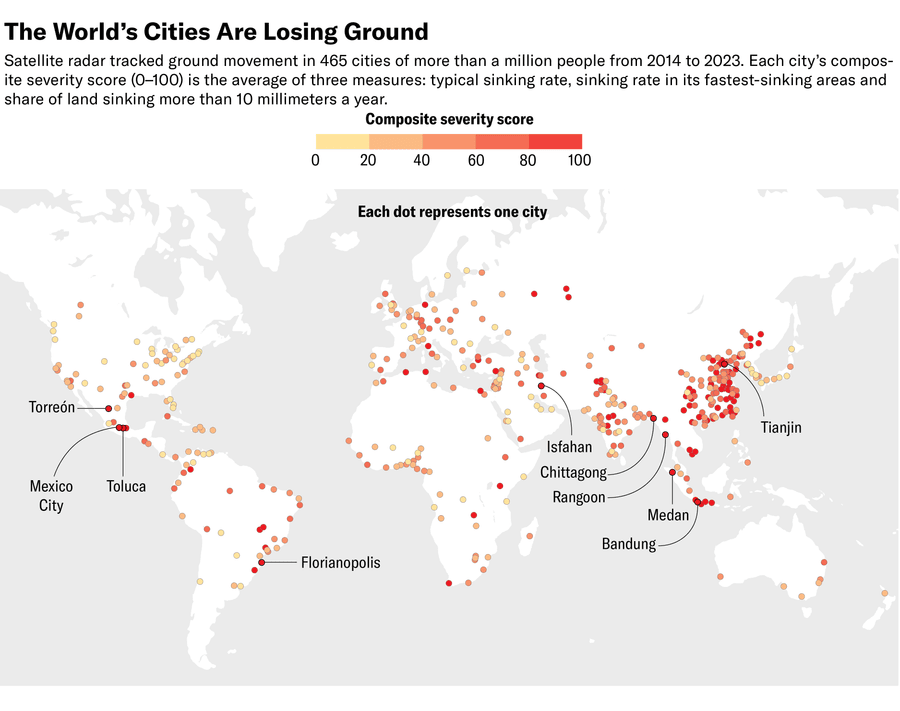
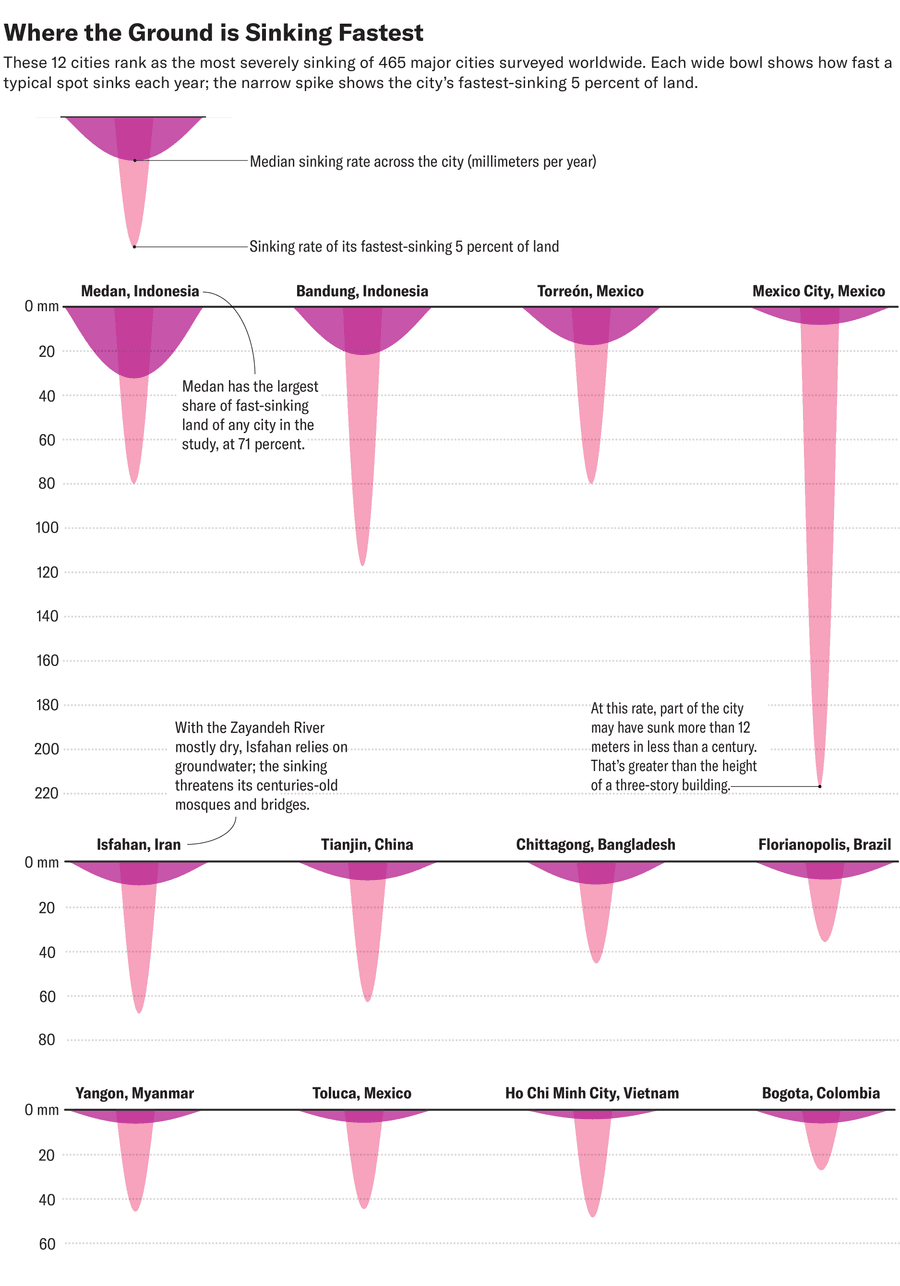
Major cities across the world—including hotspots such as New Orleans, Mexico City, Jakarta and Rome—are sinking by up to several inches every year.
Those are the findings of an exhaustive new survey published in Nature Cities,in which researchers used satellite radar to track 465 urban areas of more than a million people from 2014 to 2023. The results, displayed in an interactive map, shows that sinking isn’t just “a local curiosity” for a small handful of cities, but “a global urban problem,” says study coauthor Guoquan Wang, a geophysicist at the University of Houston.
Satellites can measure the land’s gradual sinking, called subsidence, by taking radar images of the same area over time to determine the shift in the radar signal’s travel—even a change of mere millimeters (twenty-fifths of an inch) of ground can result in a signal taking slightly longer to return than the past. The new work, which examined small chunks of land—just a few houses wide—all over the world, is “the most comprehensive and systematic exploration of subsidence in urban cities,” says Roland Bürgmann, a geophysicist at the University of California, Berkeley, who was not involved in the study.
Sinking was most severe in Southeast Asia, West and Central Asia and North America, but it also turned up in South America and Africa, both of which are generally less studied in regards to land subsidence; For almost half the cities in the dataset, no satellite radar study had ever been done before.
Different factors can contribute to urban subsidence. In New York City, for instance, the weight of buildings compresses the region’s soft soils. But the biggest driver is usually water utilities, industries and other groups pumping out water from under the ground. Groundwater helps hold up the soil like air in a cushion: pump it out, and the ground slowly sags.
And the real danger is uneven sinking. “If the whole city were to smoothly subside altogether by an inch or so, it wouldn’t be that big of a problem,” Bürgmann says. But when one neighborhood drops faster than the next, the strain builds.
Over time such strain can crack foundations, break sewer lines, damage subway systems and worsen flooding. In Jakarta, the sinking and flooding has become so severe that Indonesia is building a brand-new capital city on the island of Borneo.
Once it happens, sinking is “cumulative and largely irreversible,” Wang says, but cities have successfully stopped continued subsidence before. Tokyo once sank “way faster than many cities today,” says Manoochehr Shirzaei, a geoscientist at Virginia Tech, who was a peer reviewer for the study, until officials drew up policies to halt it. These included regulations around groundwater pumping and a shift toward alternative surface water sources. In China, Beijing and the nearby city of Tianjin “stopped pumping groundwater and replaced it with surface water” piped from the Yangtze River basin, Wang says, and sinking has since halted in parts of the region.
“In most places, we have plenty of time to react,” Shirzaei says, “but we have to do it.”
This entry was posted on Tuesday, November 3rd, 2026 at 2:04 pm and is filed under Subsidence. You can follow any responses to this entry through the RSS 2.0 feed.
Both comments and pings are currently closed.
Comments are closed.
ABOUT
Black Swans / Green Shoots examines the collision between urbanization and resource scarcity in a world affected by
climate change, identifying opportunities to build sustainable cities and resilient infrastructure through the use
of revolutionary capital, increased awareness, innovative technologies, and smart design to make a difference in the
face of global and local climate perils.
'Black Swans' are highly improbable events that come as a surprise, have major disruptive effects, and that are
often rationalized after the fact as if they had been predictable to begin with. In our rapidly warming world, such
events are occurring ever more frequently and include wildfires, floods, extreme heat, and drought.
'Green Shoots' is a term used to describe signs of economic recovery or positive data during a downturn. It
references a period of growth and recovery, when plants start to show signs of health and life, and, therefore, has
been employed as a metaphor for a recovering economy.
It is my hope that Black Swans / Green Shoots will help readers understand both climate-activated risk and
opportunity so that you may invest in, advise, or lead organizations in the context of increasing pressures of
global urbanization, resource scarcity, and perils relating to climate change. I believe that the tools of business
and finance can help individuals, businesses, and global society make informed choices about who and what to
protect, and I hope that this blog provides some insight into the policy and private sector tools used to assess
investments in resilient reinforcement, response, or recovery.