

January 11th, 2024
Via RMI, a look at how US cities can leverage the new “direct pay” mechanism build on-site solar projects for local governments:
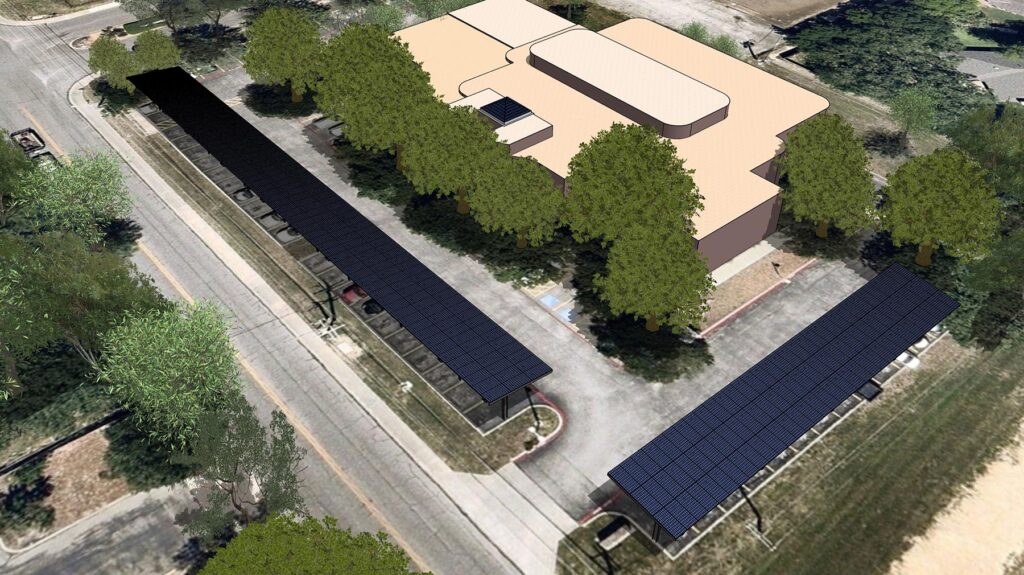
Last year, San Antonio set a new record of 75 days at or above 100°F. An innovative solar project approved by the City in November will not only provide a solution for beating the heat in the form of shaded solar canopies on parking lots, but also highlights how cities of all shapes and sizes can harness a new federal mechanism to cost-effectively invest in more clean energy.
The City of San Antonio has made history by approving a major deal with local solar developer Big Sun Solar to put an estimated 13 megawatts (MW) of solar on 42 city-owned facilities and parking lots. Most significantly, these projects will offset about 11 percent of the electricity consumption for City operations, accruing a net savings of $7–$11 million over the 25-year lifetime of the panels. These benefits and more show that clean energy is not only good for reducing pollution, but can also result in healthier, safer, and more financially resilient cities.
Rendering of the proposed solar canopies at San Antonio’s Brook Hollow Library. Image courtesy of Big Sun Solar, 2023.An Innovative Deal with Game-Changing New Incentives
Not only is this one of the largest multi-site on-site solar deals in the country, but San Antonio will also be one of the first cities to take advantage of the direct pay mechanism (also called Elective Pay) made possible by the Inflation Reduction Act (IRA). Direct pay allows cities like San Antonio and other tax-exempt entities to take advantage of tax credits to reduce upfront project costs, something that was not possible before the IRA passed in August 2022.
In 2019, San Antonio adopted its SA Climate Ready plan with goals of net-zero energy for municipal buildings by 2040 and carbon neutrality by 2050. Prior to the IRA, the City was exploring complicated third-party structures because it could not purchase the solar panels and claim the clean energy tax credits as a tax-exempt entity. However, direct pay opened up a new pathway of funding for projects like this, allowing the City to own these solar projects, rather than contract with a third party. This ultimately enables the City to capture more of the financial benefits of the project while meeting its climate and energy goals.
Four Lessons for Cities Looking to Learn from San Antonio
- Make small projects into a bigger deal: First, the beauty of this solar deal is that it will be made up of multiple small projects, spread out across the city and in multiple districts. Rather than one large solar farm on a field, this distributed approach demonstrates how renewable energy can productively use already developed rooftops and parking lots — all while capturing greater economies of scale with a far more streamlined procurement than pursuing sites one-by-one.
- Carefully consider which requirements are relevant: Having multiple smaller sites gives San Antonio another advantage: because the projects are all individually under 1 MW, they’re not required to meet new domestic content requirements to receive the full Investment Tax Credit. In addition, some of the city’s facilities will be able to take advantage of tax credit bonuses — additional credits projects can receive for being located in a qualifying energy community or low-income community. Overall, IRA tax credits are expected to cover 30–40 percent of the upfront cost.
- Mind the gap (and plan for it): Cities considering using direct pay to capture IRA tax credits should anticipate that the “refund” equivalent to the tax credits may not arrive for more than a year after the project is placed in service. In this way, direct pay functions more like a reimbursable grant — where the initial costs are still paid by the city. Accordingly, cities should ensure that they can finance all the upfront capital costs initially, even if they pay back a substantial portion of that debt upon receiving the direct pay credit. Similar to how San Antonio finances other infrastructure projects, the city is financing the capital costs with a combination of taxable bonds and a low-interest loan specifically for energy saving projects from the Texas State Energy Conservation Office.
- Allow for strategic flexibility in procurement: In particular, cities and other local governments may consider issuing requests for proposals, like San Antonio did, that allow for flexibility in the number of sites and contract type. While this can add more complexity upfront to the procurement process, this approach may result in more cost-effective proposals and further insight into the financial impact direct pay. For instance, in San Antonio’s case, allowing developers to propose multiple scenarios allowed the City to evaluate the economics of adding solar at different facilities and whether it would prefer to directly own the solar facilities or leverage a third-party model (i.e., a power purchase agreement or lease). To consistently compare across a range of financial structures, the City assessed the net present value of each proposal’s costs and benefits. This helped San Antonio identify which project would result in the best value over 25 years, not just the lowest cost upfront.
Charting Uncharted Territory
Despite the justifiable enthusiasm for the clean energy tax credits and direct pay, they are still uncharted territory. While it is a game-changing mechanism, direct pay is no panacea. For projects greater than 1 MW in capacity, domestic content will be required to capture the tax credit after 2025. And the rules of your energy market may impact how you can buy or sell electricity.
Early examples like San Antonio’s 13 MW deal can highlight how local governments and other tax-exempt organizations can pragmatically factor the IRA directly into its planning, procurement, and evaluation. And such innovative local solar deals tangibly demonstrate how transformative federal clean energy incentives can be in daily life and inspire additional projects in San Antonio, in Texas, and across the United States.
'Black Swans' are highly improbable events that come as a surprise, have major disruptive effects, and that are often rationalized after the fact as if they had been predictable to begin with. In our rapidly warming world, such events are occurring ever more frequently and include wildfires, floods, extreme heat, and drought.
'Green Shoots' is a term used to describe signs of economic recovery or positive data during a downturn. It references a period of growth and recovery, when plants start to show signs of health and life, and, therefore, has been employed as a metaphor for a recovering economy.
It is my hope that Black Swans / Green Shoots will help readers understand both climate-activated risk and opportunity so that you may invest in, advise, or lead organizations in the context of increasing pressures of global urbanization, resource scarcity, and perils relating to climate change. I believe that the tools of business and finance can help individuals, businesses, and global society make informed choices about who and what to protect, and I hope that this blog provides some insight into the policy and private sector tools used to assess investments in resilient reinforcement, response, or recovery.