

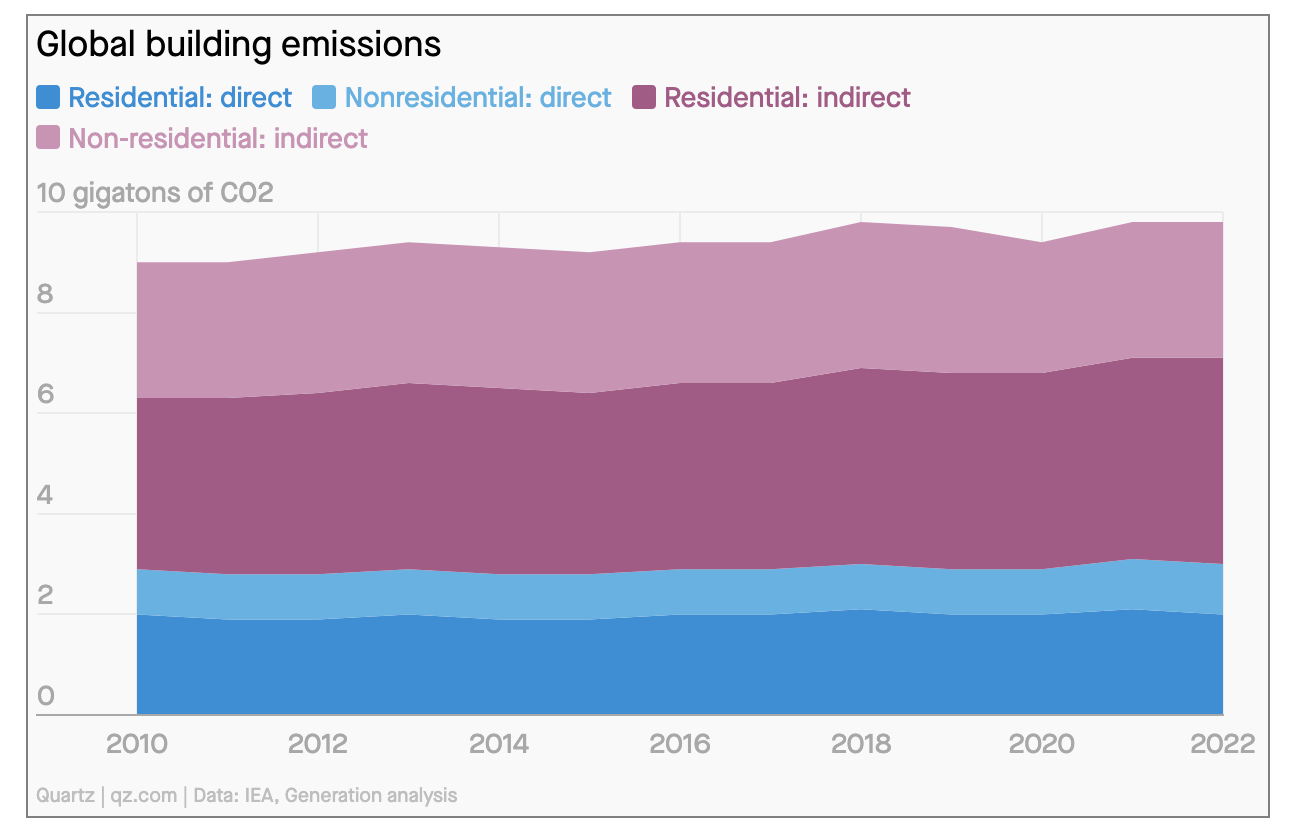
While buildings only contribute to 6% of global emissions, accounting for the use of more electricity and a structure’s materials can triple the size of a building’s carbon footprint, according to a new report by Generation, a sustainable investment firm. Historical data from the International Energy Association (IEA) shows that buildings haven’t made big strides in reducing their carbon footprint, remaining more or less the same since 2010. But as the energy transition points toward more electrification, using electricity efficiently will be critical to reducing emissions in the places where people live and work everyday.
The lifecycle of building emissions can be broken down into three categories: materials and construction, operational, and replacement or demolition. These phases make up 30%, 50%, and 20% of a building’s emissions, respectively, according to the World Business Council for Sustainable Development (WBCSD). Authors of the report claim that too little attention has been paid to indirect or embedded emissions produced through sourcing materials and using electricity. Indirect emissions are different from direct emissions in that buildings themselves do not generate electricity, for example, but still consume it to function.
Increasing demand for electricity in buildings
As more homes and commercial buildings turn to efficient LED lights, heat pumps, and solar water heating, the sourcing of their electricity should still be considered. While the electrification of buildings has the potential to put excessive new loads on the power grid, technology offers a way to avoid that outcome. In fact, the authors of the Generation reportclaim, buildings could become a major asset to the power grid, helping to balance out fluctuations in the supply of electricity as more and more renewables connect to the system.
One way to do this might be having power companies send signals to customer equipment to manage demand. California has already set the precedent for electricity demand management, where electricity providers offer opt-in rates based on real-time electricity costs. Cost-based rates incentivize customers to use electricity when the grid is cleanest—and demand is lowest.