California Is Running Out of Safe Places to Build Homes Due to Fires, Rising Seas July 4th, 2025
Via Bloomberg, a look at how climate-related risks hamper the state’s ability to solve a housing crunch. It’s not alone.
California, gripped by a housing shortage that is forcing families from the state, wants to build 2.5 million homes. But it’s running out of safe places to put them.
Much of the land best suited for new housing — wind-swept, grassy hills surrounding the state’s major cities — now faces an extreme threat of wildfire, brutally illustrated by the Los Angeles-area blazes in January that killed 30 people and destroyed more than 16,000 structures. Fires have also leveled entire towns in the Sierra Nevada foothills, often considered an affordable place to buy a home. With California’s peak fire season on the way, the state’s main firefighting agency recently updated its maps showing the places at risk, and the danger zone now encompasses an area the size of Georgia.
The California coast, meanwhile, confronts the long-term threat of rising seas. The state forecasts eroding coastlines will endanger $18 billion of existing homes and commercial buildings in the coming decades, and San Francisco officials have already decided to close part of one seaside highway rather than defend it.
Governor Gavin Newsom set the state’s ambitious housing-production goal, trying to solve a larger cost-of-living crisis that has tarnished California’s image and threatens its economy. Many in the Democrat-led legislature have jumped in, embracing the “abundance” doctrine of cutting red tape that hinders building. Newsom this week signed legislation that will exempt many housing projects from a key environmental law to speed development. But the effort faces the challenge — made worse by a changing climate — of finding appropriate places to build.
Where New Housing Is Exposed to Fire Risk
In the Los Angeles area, more than 125,000 housing permits issued from 2018 to 2024 were in areas with at least moderate fire risk, including nearly 500 in places later burned by the Eaton and Palisades fires
Sources: California Department of Forestry and Fire Protection, California Department of Housing and Community Development
Note: Fire hazard zones in Federal Responsibility Areas are not shown
California is hardly alone in seeing climate-related limits to growth. In Arizona, groundwater restrictions have halted construction of more than 150,000 housing units, and one developers’ association estimates the Phoenix area could run out of buildable land in two to three years. In the Houston area, city and county officials have offered buyouts to homeowners in areas that have proved far more flood-prone than once believed. Such issues add to a nationwide housing shortage that the Brookings Institution last year estimated had reached nearly 5 million units.
“The signals are starting to happen now, and we’re starting to see limited development because of the better understanding of what the risks are,” said Carlos Martín, director of the Remodeling Futures Program at the Harvard Joint Center for Housing Studies. “It’s really a fine-tooth comb that you have to look through, in terms of all the available land.”
To be sure, California’s housing crisis is — in several key ways — self-made. Residents have repeatedly voted to shield open space and farmland from development in places such as Marin County, north of San Francisco, and Ventura County, near Los Angeles. Environmental concerns and community opposition have held up projects across the state. California policymakers have tried to spur construction of apartment buildings within cities to ease the crunch, but some local governments refuse to cooperate. Development of single-family homes has increasingly been pushed into the agricultural Central Valley, away from most major job centers.
The state’s median price for a single family home now stands at $900,000, according to the California Association of Realtors — a cost few residents can pay. In the San Francisco Bay Area, it’s $1.4 million. And yet, the eye-watering prices — and Newsom’s efforts — haven’t triggered a construction boom. About 101,500 new housing units received permits across the state last year, according to the US Census Bureau’s Building Permits Survey. That’s a 9% drop from the previous year and the state’s lowest annual total since 2015.
No Housing Boom in California
Number of new units receiving permits in the state
Source: US Census Bureau Building Permits Survey
Despite the need for new housing, years of traumatic wildfires have made many local officials leery of allowing construction in risky spots. Last year, Anaheim rejected a 498-unit apartment complex that would have been tucked into a canyon near a Costco, because it could have added 24 minutes to neighborhood evacuation times in the event of a fire.
“We’ve had a couple of previous fires that impacted these communities, and for some of these people, it took three hours to get out,” said Mayor Pro Tem Natalie Meeks, who voted against the project. “In light of what happened in the Palisades and Altadena, three hours — that’s a death sentence.”
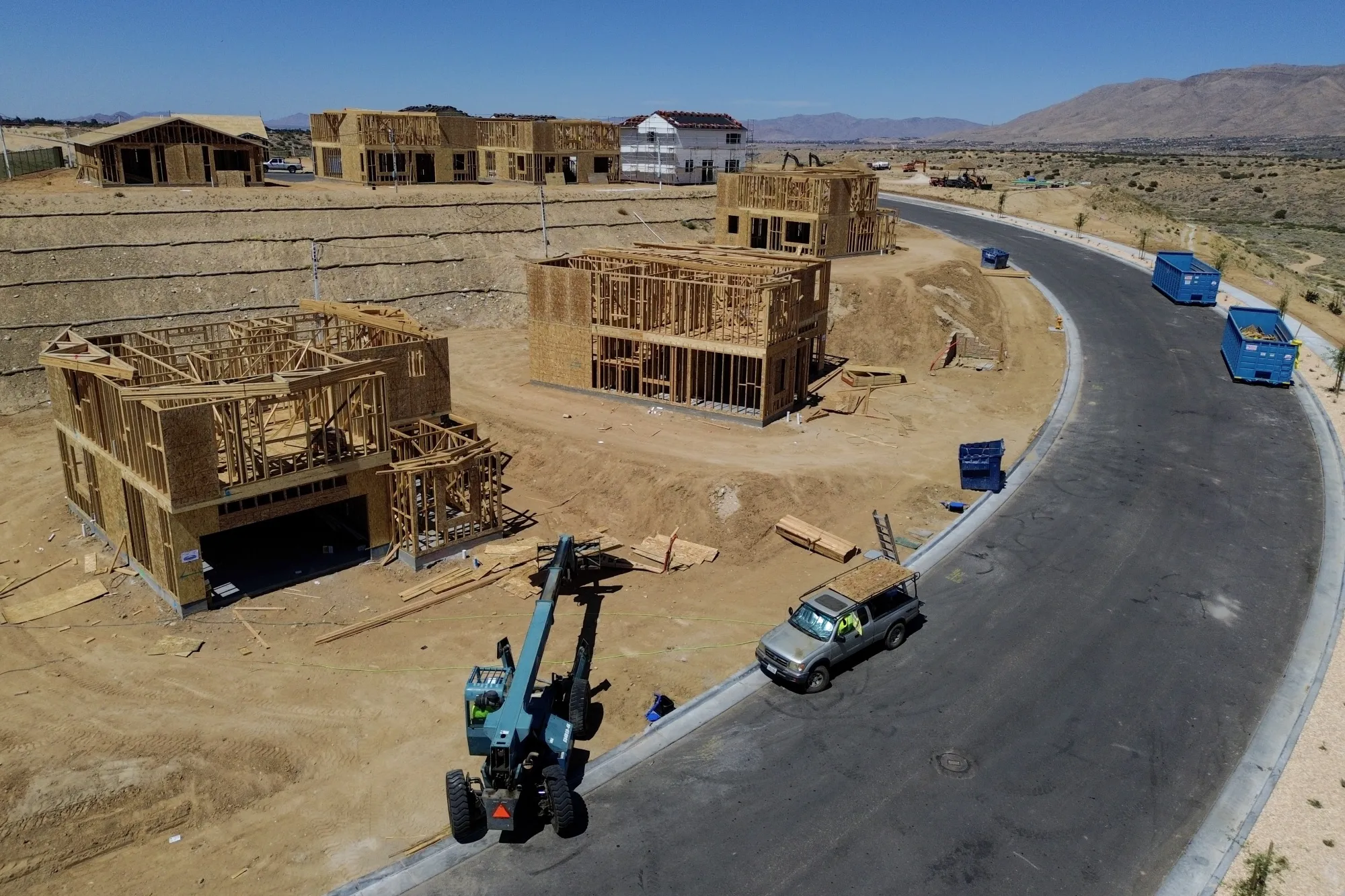
And the areas considered to be at high risk have spread, after years of on-and-off drought. Developer John Ohanian is overseeing construction of one of the state’s largest housing projects, more than 15,000 homes framed by the San Bernardino Mountains northeast of Los Angeles. Dubbed Silverwood, the development offers wildflower-studded hills, hiking trails — and the possibility of ownership for middle-class buyers. But just weeks before Ohanian planned a grand opening, the state’s firefighting agency redrew its wildfire hazard maps. Silverwood, once outside the hazard zone, now lies in the highest tier of risk, showing bright red on the state maps.
“They dropped a bomb on us,” Ohanian said. “It was a stunning change in fire risk. So we’re all dealing with it.”
Growing Risks for Planned Housing
Newly updated fire hazard zone borders place the Silverwood project in a very high risk area
Sources: California Department of Forestry and Fire Protection, California Department of Housing and Community Development
Note: Fire hazard zones in Federal Responsibility Areas are not shown
It wasn’t just Ohanian’s project. The California Department of Forestry and Fire Protection, or Cal Fire, added about 1.4 million acres to the high and very high fire hazard zones in the latest map updates. More than 59,000 square miles now face moderate to very high fire risk.
“If they’re in one of these zones, there’s really a very non-zero chance fire is going to visit them,” said David Sapsis, a Cal Fire researcher who led the mapping project.
The changes won’t block future construction at Silverwood, whose homes already feature non-flammable roofs, sprinkler systems and ember-resistant vents. But Ohanian anticipates added expenses, such as wider roads to prevent evacuation gridlock and using costly tempered glass that won’t shatter as easily during a fire. Potential buyers could have difficulty finding insurance on the private market, a significant deterrent. They may have to rely on the state-run insurer of last resort, which offers pricey but bare-bones coverage. Some may balk at buying a home that may not still be standing in a few decades.
Still, he remains optimistic the desire for ownership, combined with fire-resistant construction, will win over potential buyers. “The big thing is price — people are coming here because they’re just getting hammered everywhere else,” Ohanian said. “Unless they stop having babies, they’re going to still need houses.”
Silverwood, once outside the hazard zone, now lies in the highest tier of risk.Photographer: Eric Thayer/Bloomberg
Similar dilemmas are playing out in Arizona, where entire cities have risen from the desert by drilling for groundwater. Before a new community can be built, the state must give the green light that the development has enough groundwater for the next 100 years. In 2023, state officials said the aquifers around Phoenix could no longer support the 100-year requirement, effectively blocking much new groundwater-dependent growth. More than 150,000 planned housing units remain on hold, according to the state’s largest home builders association.
“The kind of home building that has been so much a hallmark of growth in the Phoenix area, the kind of sprawling exurban development – that is pretty much paused,” said Sarah Porter, director of the Kyl Center for Water Policy at Arizona State University.
Private investors now face billions of dollars in sunk costs with no returns on the horizon, said Spencer Kamps, legislative director for the Home Builders Association of Central Arizona, whose organization is suing the state over the restrictions. “As housing prices continue to increase and housing options are diminished, the only option is going to be rentals,” he said.
The state’s largest housing development — Teravalis, expected to house 300,000 residents about 35 miles west of Phoenix — only has water access for a fraction of the project. Another 2,500 homes planned at nearby Verrado could face delays. Charley Freericks, who is heading the Teravalis project for Howard Hughes Holdings Inc., said the company has a decades-long horizon for completing construction and is working with elected officials to push forward the entire build-out. “The need for new housing in the Phoenix West Valley is urgent,” he said.
For parcels that still have access to grandfathered water rights, known as “cause,” land values are many times higher, said developer Anita Verma-Lallian. Land in Queen Creek southeast of Phoenix, she said, can sell for hundreds of thousands of dollars per acre if it has assured water, while nearby property without those rights can be largely worthless to developers. Her firm has started buying cheap land impacted by the groundwater restrictions and rezoning it for industrial uses, which do not face the 100-year groundwater requirement. Meanwhile, cities are scrambling to find new sources of water by shipping it from elsewhere and building costly infrastructure to keep builders building.
“If you have a property with cause, it’s like having gold in Arizona,” Verma-Lallian said.
This entry was posted on Friday, July 4th, 2025 at 12:42 am and is filed under Insurance, Sea Level Rise, Wildfire. You can follow any responses to this entry through the RSS 2.0 feed.
Both comments and pings are currently closed.
Comments are closed.
ABOUT
Black Swans / Green Shoots examines the collision between urbanization and resource scarcity in a world affected by
climate change, identifying opportunities to build sustainable cities and resilient infrastructure through the use
of revolutionary capital, increased awareness, innovative technologies, and smart design to make a difference in the
face of global and local climate perils.
'Black Swans' are highly improbable events that come as a surprise, have major disruptive effects, and that are
often rationalized after the fact as if they had been predictable to begin with. In our rapidly warming world, such
events are occurring ever more frequently and include wildfires, floods, extreme heat, and drought.
'Green Shoots' is a term used to describe signs of economic recovery or positive data during a downturn. It
references a period of growth and recovery, when plants start to show signs of health and life, and, therefore, has
been employed as a metaphor for a recovering economy.
It is my hope that Black Swans / Green Shoots will help readers understand both climate-activated risk and
opportunity so that you may invest in, advise, or lead organizations in the context of increasing pressures of
global urbanization, resource scarcity, and perils relating to climate change. I believe that the tools of business
and finance can help individuals, businesses, and global society make informed choices about who and what to
protect, and I hope that this blog provides some insight into the policy and private sector tools used to assess
investments in resilient reinforcement, response, or recovery.