Systemic Cooling Poverty: A New Facet of Deprivation Emerging In A Warming World October 11th, 2023
Via Phys.org, a new study underscoring the rising “cooling gap” and an increase in cooling poverty, highlighting growing equity issues arising as the climate warms. The study showed that “The poorest and most disadvantaged people, who contributed the least to global warming, are the ones bearing the most severe consequences of extreme heat because of their limited adaptive capacity” because of building materials, passive cooling infrastructures, social infrastructures, and indoor and outdoor heat protection. The study introduces a new idea of “systemic cooling poverty.”
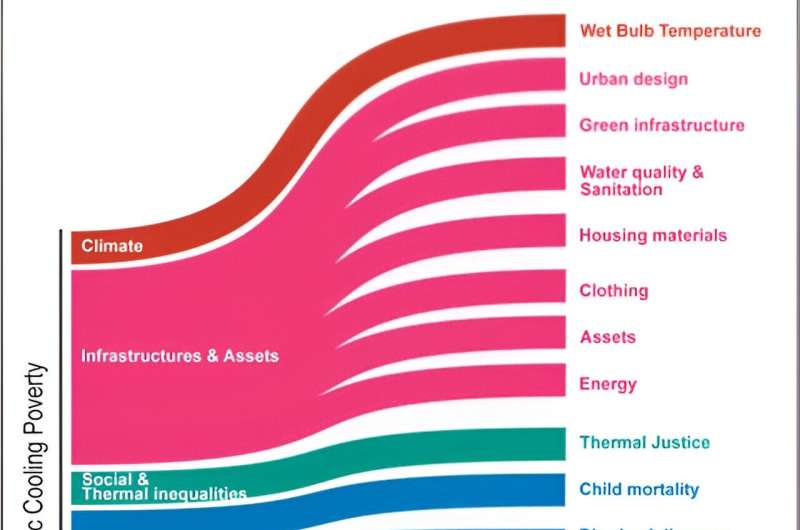
The proposed framework with the five core dimensions defining systemic cooling poverty and its 15 sub-dimensions or variables. The framework builds on the Multidimensional Poverty Index (MPI) developed by Oxford Poverty and Human Development Initiative (OPHI)35, putting the health and education dimensions of human well-being at the core. Credit: Mazzone A et al.
A new study in Nature Sustainability—published by researchers from Oxford University, Ca’ Foscari University of Venice, the Euro-Mediterranean Center on Climate Change, the European Institute on Economics and the Environment and the London School of Hygiene & Tropical Medicine—brings attention to a new relevant dimension of deprivation that is clearly emerging in a warming world: cooling poverty.
The study highlights the multidimensional nature of cooling poverty and introduces the new concept of systemic cooling poverty.
Cooling poverty can be defined as systemic because it develops in a context in which organizations, households, and individuals are exposed to the detrimental effects of increasing heat stress mainly because of inadequate infrastructures.
Such infrastructures include physical assets (such as passive retrofit solutions, cold chains, or personal technological cooling devices), social systems (as networks of support and social infrastructures), and intangible resources (such as knowledge, to intuitively adapt to the combined effects of heat and humidity).
The study identifies five core dimensions that interact with each other, defining together the proposed concept of systemic cooling poverty: Climate, Thermal comfort Infrastructures & Assets, Social and thermal inequality, Health, and Education and Work standards.
The lead author of the study, Antonella Mazzone—a research affiliate with the University of Oxford—points out that “the proposed definition departs from existing concepts of energy and fuel poverty. It highlights the role of passive cooling infrastructures (water, green, and white surfaces), building materials for adequate outdoor and indoor heat protection, and social infrastructures.
“Its systemic scope also considers the state of available cooling provision for outdoor working, education, health, and refrigeration purposes. In this sense, space, and place play a key role in this conceptualization of cooling poverty. It goes beyond energy and embraces a multidimensional, multi-leveled analysis of infrastructures, spaces, and bodies.”
Enrica De Cian, professor at Ca’ Foscari University of Venice and senior researcher at Euro-Mediterranean Center on Climate Change (CMCC), co-author of the study, emphasizes how “the concept has many important policy implications, as it points at the importance of addressing the risks related to heat exposure with effective coordination between different sectors, such as housing, health care, food, and agriculture, transports.”
This new index can help governments to timely and ethically program the most needed cooling intervention while accounting for important tradeoff considerations. “The next challenge will be to render the proposed systemic cooling poverty framework fully operational in diverse contexts and at different scales, as we wish to pursue in future research work,” says Giacomo Falchetta, a scientist at the CMCC who contributed to the study.
This entry was posted on Wednesday, October 11th, 2023 at 1:33 pm and is filed under Extreme Heat, Green Design. You can follow any responses to this entry through the RSS 2.0 feed.
Both comments and pings are currently closed.
Comments are closed.
ABOUT
Black Swans / Green Shoots examines the collision between urbanization and resource scarcity in a world affected by
climate change, identifying opportunities to build sustainable cities and resilient infrastructure through the use
of revolutionary capital, increased awareness, innovative technologies, and smart design to make a difference in the
face of global and local climate perils.
'Black Swans' are highly improbable events that come as a surprise, have major disruptive effects, and that are
often rationalized after the fact as if they had been predictable to begin with. In our rapidly warming world, such
events are occurring ever more frequently and include wildfires, floods, extreme heat, and drought.
'Green Shoots' is a term used to describe signs of economic recovery or positive data during a downturn. It
references a period of growth and recovery, when plants start to show signs of health and life, and, therefore, has
been employed as a metaphor for a recovering economy.
It is my hope that Black Swans / Green Shoots will help readers understand both climate-activated risk and
opportunity so that you may invest in, advise, or lead organizations in the context of increasing pressures of
global urbanization, resource scarcity, and perils relating to climate change. I believe that the tools of business
and finance can help individuals, businesses, and global society make informed choices about who and what to
protect, and I hope that this blog provides some insight into the policy and private sector tools used to assess
investments in resilient reinforcement, response, or recovery.